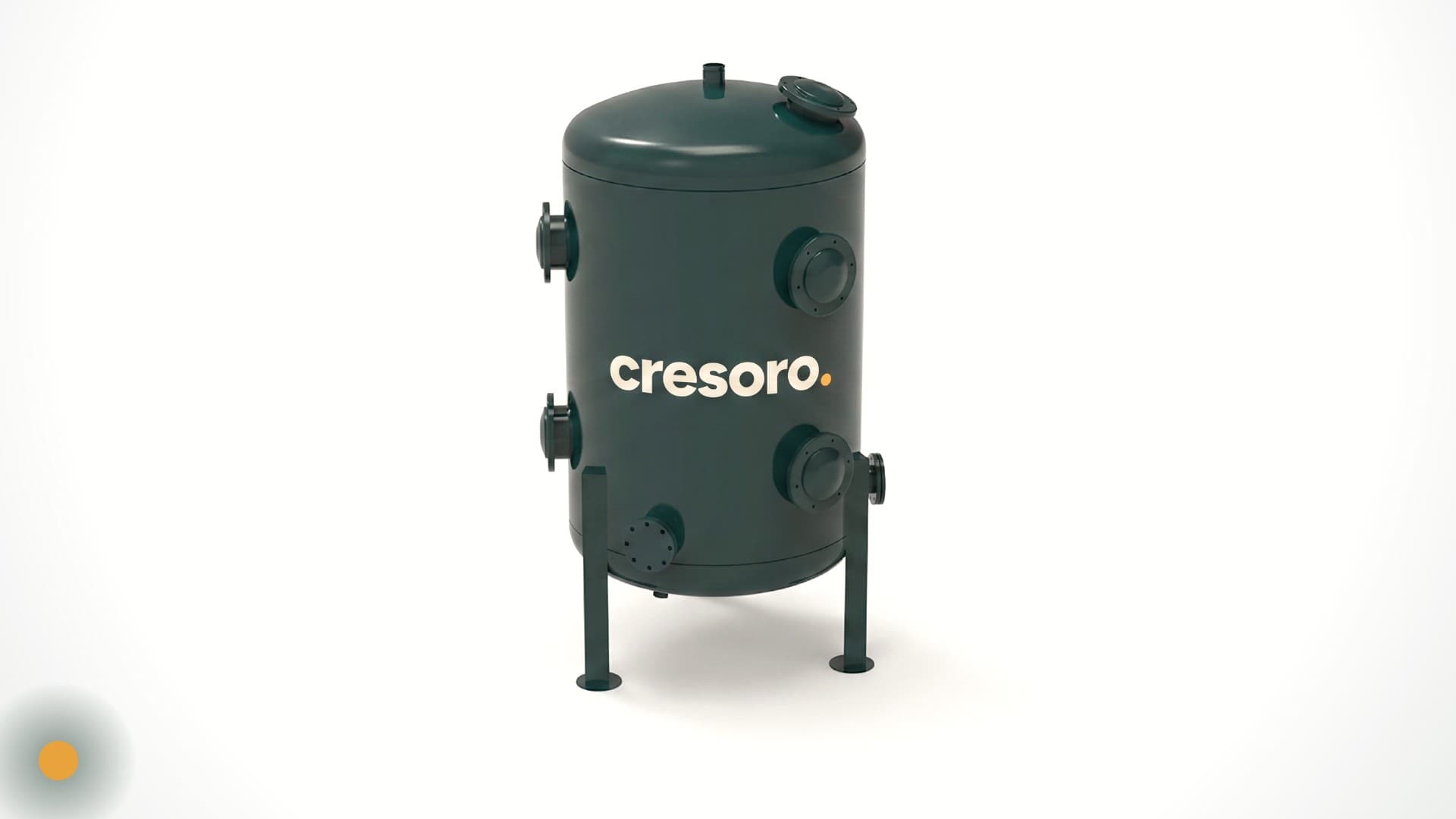
A media filter does its job by getting dirty. Water comes in the top, passes down through a bed of graded sand or other media, and the dirt gets trapped in the bed while clean water leaves the bottom. That works right up until the bed is full of trapped sediment — and then the filter has to clean itself, by reversing the flow and flushing the dirt back out. That reverse flush is the backwash, and it's the part that decides whether your filter keeps working or quietly fails. Get it wrong and the most expensive vessel on the system becomes dead weight.
So it's worth understanding what the backwash is actually doing, and the two ways it goes wrong.
What a good backwash actually does
In normal operation the media bed is packed down, settled, doing its filtering. To clean it, you reverse the flow and push water up through the bed from below. Done right, that upward flow lifts and separates the media grains — the bed expands, the grains start to move and tumble against each other, and the trapped dirt is knocked loose and carried up and out to waste. The technical word is fluidisation: the bed has to lift and float, not just get rinsed. A bed that lifts and tumbles gets clean. A bed that sits there while water trickles past it does not.
That's why backwash flow rate is the number that matters more than almost any other spec on a media filter. It's not a detail — it's the whole cleaning mechanism. And it has a window: too little flow and too much both fail, in different ways.
When there's not enough backwash flow
This is the common one, and it's quiet. If the upward flow can't lift and fluidise the bed, the dirt never properly comes loose. The filter goes through its backwash cycle, looks like it's working, and comes back into service still partly dirty. Do that enough times and the trapped sediment compacts into hard lumps — mud-balls — and the bed starts to crack and form channels, especially down the walls of the vessel.
Once the bed channels, you've lost the filter. Water takes the path of least resistance straight through the cracks instead of filtering evenly through the media, so dirty water short-circuits to the outlet and out to your driplines. The filter is still plumbed in, still cycling, still showing on the gauge — and barely filtering. A media filter that can't backwash properly is worse than no filter, because it gives you the confidence of filtration without the fact of it.
The usual cause isn't the filter. It's the water supply behind it. A media filter needs a genuine volume of clean water at pressure to backwash, and that requirement is set by the surface area of the bed — the tank diameter — not the volume of media in it. A bigger tank filters more but also demands more backwash flow, and if the pump or the source can't deliver that flow, the bigger tank actually performs worse than a smaller one would. This is why irrigation media filters come in banks of two or more vessels: one tank's filtered output supplies the backwash for the tank being cleaned, one at a time. A single media tank often can't clean itself at all.
When there's too much backwash flow
The opposite failure is louder and more obvious. Push too much flow up through the bed and you don't just fluidise the media — you carry it out the top, into the waste line, gone. You lose media every backwash, the bed gets shallower, filtration drops, and eventually you're backwashing sand into a ditch. The fix is a throttle valve on the backwash discharge to hold the flow in the window: enough to lift and tumble the bed, not so much that it floats the media out of the tank.
The takeaway
When you're sizing or buying a media filter, the question isn't only how fine it filters or how big the tank is. It's whether the system behind it can actually backwash it — the right flow, from enough clean water, controlled so the bed lifts but the media stays put. A filter that can't clean itself isn't a filter for long. It's a tank full of dirt with a pressure gauge on it.
If you're speccing one, work out the backwash flow your tank diameter needs first, then check your pump and supply can deliver it. Everything else about the filter is academic if it can't clean its own bed.